|
|
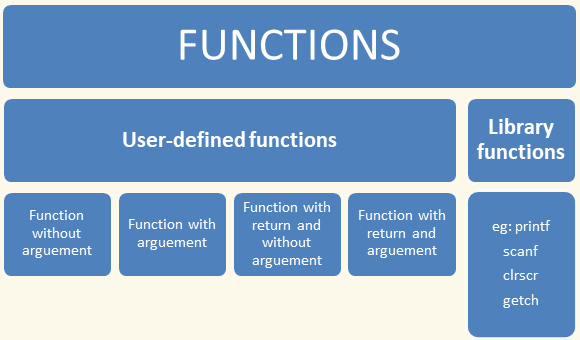
Functions divide the larg part of the program into small parts which makes the program code organised and easy to read.
Defining a function involve three steps in the program code. these are:-
When a function has no arguements, it does not recieve any data from the calling function. Similarly function with no return does not recieve any data from the called function.
| Syntax | Input | Output |
|---|---|---|
#include<stdio.h>
void main()
{
void abc();   (Function decalaration)
abc();        (Function calling)
}
void abc()    (Function
{               B
________;       O
________;       D
}               Y)
|
#include<stdio.h>
void main()
{
void add();
void sub();
clrscr();
add();
sub();
getch();
}
void add()
{
int a,b,c;
printf("enter a=");
scanf("\n%d",&a);
printf("\nenter b=");
scanf("\n%d",&b);
c=a+b;
printf("\na+b=%d",c);
}
void sub()
{
int a,b,c;
printf("\nenter a=");
scanf("%d",&a);
printf("\nenter b=");
scanf("%d",&b);
c=a-b;
printf("\na-b=%d",c);
}
|
When a function has arguements, the variables are declared with function declaration, and it recieves data from the calling function.
| Syntax | Input | Output |
|---|---|---|
#include<stdio.h>
void main()
{
void abc(int a,int b);   (Function decalaration)
abc(10,20);              (Function calling)
}
void abc(int a,int b)    (Function
{                         B
________;                 O
________;                 D
}                         Y)
|
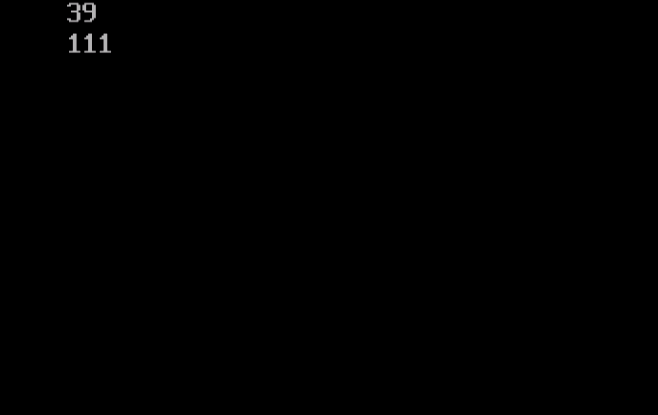
#include<stdio.h>
void main()
{
void add (int a, int b);
clrscr();
add(19,20);
add(45,66);
}
void add(int a, int b)
{
int c;
c=a+b;
printf("%d\n",c);
}
|
 |
In a function with return, it recieves data from the called function.
| Syntax | Input | Output |
|---|---|---|
#include<stdio.h>
void main()
{
int abc();                (Function decalaration)
printf("%d",abc());       (Function calling)
}
int abc()                 (Function
{
int c;                        B
________;                     O
________;
return(c);                    D
}                             Y)
|
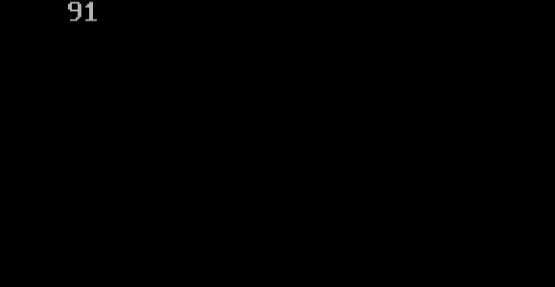
#include<stdio.h>
void main()
{
int add();
int percentage;
clrscr();
add();
percentage=add()/3;
printf("%d",percentage);
getch();
}
int add()
{
int phys,chem,bio,total;
phys=89;
chem=90;
bio=95;
total=phys+chem+bio;
return(total);
}
|
 |
In a function with return and with arguement, it recieves data from the called function and also from the calling of function.
| Syntax | Input | Output |
|---|---|---|
#include<stdio.h>
void main()
{
int abc(int a,int b);          (Function decalaration)
printf("%d",abc(34,45));       (Function calling)
}
int abc(int a,int b)           (Function
{
int c;                          B
________;                       O
________;
return(c);                      D
}                               Y)
|
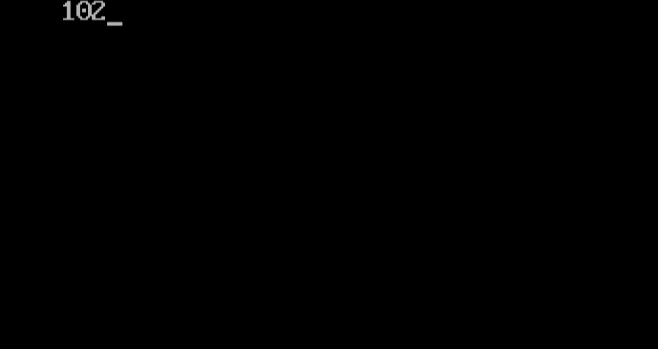
#include<stdio.h>
void main()
{
int add(int a, int b);
int d;
clrscr();
d=add(40,50)+12;
printf("%d",d);
getch();
}
int add(int a, int b)
{
int c;
c=a+b;
return(c);
}
|
 |